
SmartQuoteInsure.com is a free comparison service, not an insurance company, and may be compensated by partners. Coverage varies by policy and state.
It’s 3:40 on Thanksgiving afternoon. Dana has the stuffing in one hand, the oven timer beeping, and a doorbell announcing her in-laws, forty minutes early. On the back burner, the pan she’d set out to brown the sausage has been heating, forgotten, for a while. Then she smells it, and turns to see a thin gray wisp curling off the oil. (Dana is made up, an illustrative host. That moment is not.)
🏠 Before Thursday
If the smoke alarm went off mid-dinner, would you know what your policy covers?
Take a look at your home coverage before the big cook, and compare home insurance quotes side by side.
Free · A few quick questions · No obligation to buy
What she does in the next ten seconds matters more than anything else on the menu. What her insurance does afterward matters too, and it’s easier to sort out before the holiday than after. If you’re hosting this year, it’s a good week to check your homeowners coverage and compare home insurance quotes. First, though, the stove.
Thursday is the peak
Dana is cooking on the busiest day of the year for kitchen fires. The National Fire Protection Association (NFPA) says Thanksgiving is the peak day for U.S. home cooking fires, with more than three times the daily average. NFPA estimates 1,139 home cooking fires were reported to U.S. fire departments on Thanksgiving Day in 2024. Christmas Day and Christmas Eve rank second and third.
The cause is usually not exotic. NFPA says unattended cooking is the leading contributing factor in home cooking fires and fire deaths. As NFPA’s Lorraine Carli put it this month, when people are “preparing multiple dishes and entertaining guests, along with other distractions, it’s that much easier to lose sight of what’s on the stove or in the oven.” That’s Dana, exactly.
Lid on, heat off, no water
Smoke is the warning. NFPA calls it “a danger sign that the oil is too hot” and says that if you see wisps of smoke, turn off the burner right away. Dana reaches for the knob. But the oil is past the warning stage, and a lick of flame jumps up from the pan.
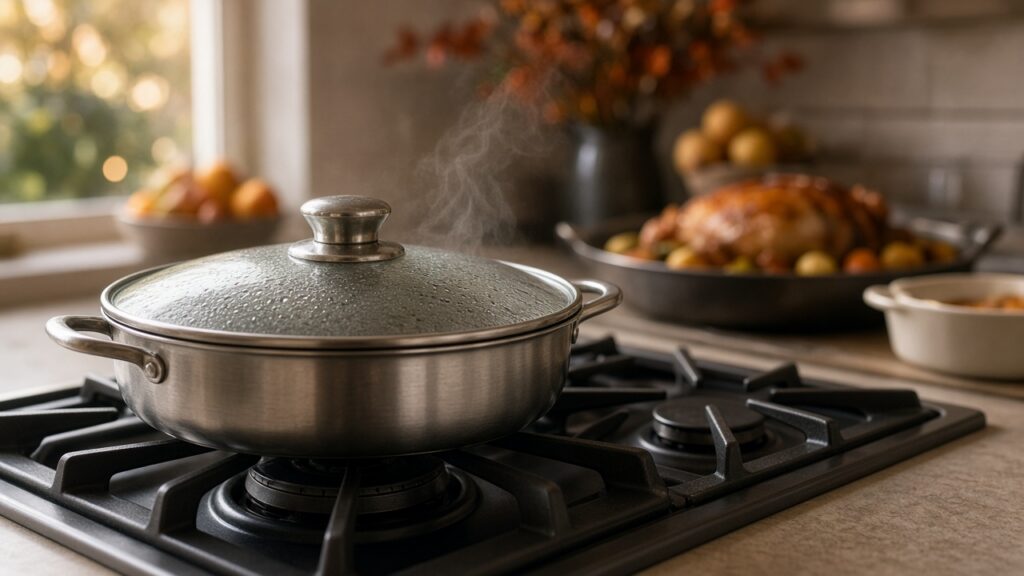
Here’s what fire officials say to do with a small grease fire, and what Dana does. NFPA’s advice is to slide the lid over the pan and turn off the burner, then leave it alone: “Do not remove the cover because the fire could start again. Let the pan cool for a long time.” The U.S. Fire Administration adds: do not move the pan. And the rule everyone should know: “Never throw water on the fire.” The Consumer Product Safety Commission (CPSC) says the same: “Never use water on a grease fire.”
Know when to stop, too. NFPA says that if the fire doesn’t go out, or you don’t feel comfortable sliding a lid over the pan, get everyone out of your home and call the fire department from outside. For an oven fire, NFPA says to turn off the heat and keep the door closed.
Dana’s lid goes on. The flame dies. The kitchen smells terrible, the cabinet above the stove is scorched, and her father-in-law is holding the door open to let the smoke out. Everyone is fine.
🔥 Lid on. Heat off.
You know where the lid is. Do you know your deductible?
A fire plan covers the next 30 seconds. Your homeowners policy may help with what comes after. See how home insurers compare for the house you own or the one you’re buying.
Free · A few quick questions · No obligation to buy
A word about the turkey fryer
If someone in your family is planning to deep-fry the bird, NFPA “strongly discourages the use of turkey fryers that use cooking oil, which can cause devastating burns,” and suggests alternatives: an infrared fryer, an air fryer or an electric turkey fryer, or buying a fried turkey from a grocery store or restaurant. The CPSC says turkey fryers create “particular risks, causing fires, injuries and property damage,” and offers a COOK checklist: carefully follow the manufacturer’s instructions, never overheat the oil, never overfill it, and keep the fryer out of the garage, off the deck and away from the house.
Where insurance comes in
A scorched cabinet is one thing. A bigger kitchen fire is another. According to the Insurance Information Institute (Triple-I), standard homeowners policies provide coverage for disasters such as damage due to fire, and pay to repair or rebuild your home if it’s damaged or destroyed by fire. Belongings destroyed by fire are generally covered, too.
If the damage makes the house unlivable, Triple-I says additional living expenses (ALE) coverage “pays the additional costs of living away from home,” such as hotel bills and restaurant meals above your usual costs, while it’s repaired. Triple-I notes that ALE has limits, and some policies set a time or dollar cap. Policies differ, so check yours for the details.
Do this tonight
Three days out, three jobs. First, test your smoke alarms; the U.S. Fire Administration says to test them monthly. Second, find the lid that fits your biggest pan and keep it beside the stove while you cook. Third, open your homeowners policy. Check your dwelling coverage: the National Association of Insurance Commissioners (NAIC) says it “should equal the full replacement cost of your home,” which isn’t the same as market value. Then find your deductible, the amount the NAIC says you pay out of pocket on each claim before the policy pays. If you’re not sure what your belongings are worth, Triple-I suggests a home inventory.
Dana did all three the week after. You can do them before Thursday.
✅ Thanksgiving kitchen check
Turkey thawing. Lid found. One more thing.
- ✓ Smoke alarms tested
- ✓ Lid within reach of the stove
- ✓ Dwelling coverage and deductible checked
- ☐ Home quotes compared
Give your homeowners policy the same once-over as your kitchen. Compare home insurance quotes before the guests arrive.
Free · A few quick questions · No obligation to buy