
SmartQuoteInsure.com is a free comparison service, not an insurance company, and may be compensated by partners. Coverage varies by policy and state.
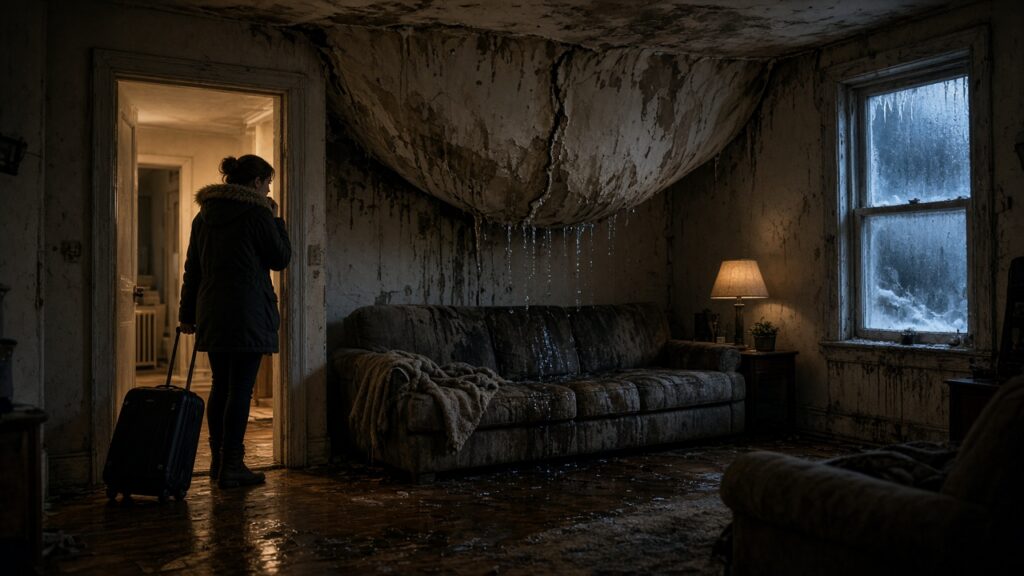
Jenna drags her suitcase up the porch steps on the Sunday night after Thanksgiving and hears it before she even finds her key: a steady hiss, like a shower running somewhere inside the ceiling. While she was at her sister’s, a cold snap rolled through. A supply line in the crawlspace above her downstairs apartment froze, split, and has been pouring water onto her couch, her laptop, and a closet full of winter coats. (Jenna is made up. Her weekend is not unusual.)
🏠 Free home quote check
Already digging out your homeowners policy?
If this story has you reading the fine print on your own home coverage, compare home insurance quotes side by side and see if you could pay less.
Free · A few quick questions · No obligation to buy
Standing in two inches of water, she pulls up her insurance app and asks the question everyone asks: who pays for this? The answer turned out to hinge on three things she’d never read: who owns what, how fast the water came out, and whether the heat was kept on. (And if a night like this has you finally reading your policies, it’s a good moment to check whether your home insurance rate still makes sense too.) She’s in big company, by the way. The Insurance Information Institute says about one in 70 insured homes has a property damage claim from water damage or freezing each year, and on homeowners policies those claims averaged $17,240 apiece from 2020 to 2024.
The ceiling isn’t hers. The couch is.
First surprise: her landlord’s insurance typically covers the building itself (the drywall, the ceiling, the floor), but not Jenna’s couch. The Insurance Information Institute notes that a landlord may have insurance to protect the building, but the landlord’s policy “won’t replace your personal possessions.” That’s what renters insurance does, covering belongings against water and the other disasters listed in the policy, plus liability and extra living expenses if a covered loss forces you out for a while. The Texas Department of Insurance puts the burst-pipe case simply: home and renters policies cover sudden and accidental water damage, and “your personal belongings are covered too.” With a renters policy, Jenna’s coats and laptop are probably a claim. Without one, they’re probably a loss. As the Texas Department of Insurance puts it, “You can always check what’s covered by reading your policy or calling your agent.”
Fast water is usually covered. Slow water usually isn’t.
Insurers draw a hard line between water that arrives all at once and water that seeps. Washington’s insurance commissioner says home insurance usually covers burst pipes, “including frozen pipes, as long as you heat your home properly,” but most policies don’t cover gradual leaks, “even if you had no way of knowing they started.” A drip that quietly rots a subfloor for months looks like a maintenance problem, not an accident.
There’s a quirk even in the fast-water case. The standard HO-3 homeowners form covers the cost to tear out and replace part of the building when that’s necessary to repair the pipe, but says “we do not cover loss to the system or appliance from which this water or steam escaped.” In plain terms, the soaked floors and ceiling, and opening the wall to reach the leak, can be covered, while the cracked pipe itself typically isn’t. Insurers’ own policies vary, so check yours.
❄️ Winter coverage check
You can’t un-burst a pipe. You can check your home rate.
For the house you own or the one you’re buying: see top home insurers side by side and find out whether another one would charge you less.
Free · A few quick questions · No obligation to buy
The heat clause
Here’s the line almost nobody reads. Most standard policies, including the HO-3 form, cover freezing of plumbing only if you used “reasonable care” to “maintain heat in the building” or to “shut off the water supply and drain all systems and appliances of water.” The NAIC, the national association of state insurance regulators, says policies generally expect a minimum temperature, or the water shut off if the home is vacant, and that if your insurer decides you neglected your plumbing, burst-pipe damage “may not be covered.”
That’s why the holiday traveler who drops the heat way down to save a few bucks is gambling. Empty buildings make insurers nervous in general: the same HO-3 form excludes vandalism if a home has been vacant for more than 60 consecutive days immediately before the loss, and Washington, D.C.’s insurance department advises shutting off and draining the water in any vacant or unoccupied property without heat. Jenna’s landlord, with the upstairs unit empty for the holiday, should pay closest attention to the heat requirement.
One more line worth knowing: water from a pipe isn’t “flood.” If rising water comes in from outside, FloodSmart, the official National Flood Insurance Program site, says most homeowners and renters policies don’t cover it. Flood policies are sold separately, renters can buy contents-only coverage, and new policies generally take 30 days to kick in, with a few exceptions, so waiting for the forecast is usually too late.
What Jenna does next, and what you can do tonight
Jenna does the right things in the right order. She shuts the water off at the main, drags the laptop and rugs off the floor, photographs everything before anything goes to the curb, and texts her landlord. The Texas Department of Insurance warns that an insurer may deny a claim if you don’t protect your property, and standard policy language asks for prompt notice, reasonable repairs to stop further damage, records of what they cost, and an inventory of what was ruined.
You can skip her Sunday night. Before you head out for Thanksgiving, find your water shut-off valve, then set the thermostat to the same temperature day and night. The American Red Cross says not to go below 55°F if you’ll be away. That number is safety advice, not a policy term. Policies typically just require reasonable care to keep the heat on or drain the water. On the coldest nights, crack open the sink cabinets and let cold water drip from faucets fed by exposed pipes. And if a pipe does freeze, the Red Cross says to thaw it with a hair dryer or heating pad, never an open flame.
Then spend five minutes with your policies: owners, find the freezing and vacancy language; renters, confirm you actually have renters coverage. It’s a lot cheaper than learning it in two inches of water.
✅ Winter checklist: last item
House is ready for the cold. Is your coverage?
- ✓ Shut-off valve found
- ✓ Thermostat set, day and night
- ✓ Policies read
- ☐ Home insurance rate checked
Give your homeowners policy the same once-over. Compare home quotes side by side and see if you could pay less. Have a car too? Bundle with auto to save more.
Free · A few quick questions · No obligation to buy